Hungary

Dr. Henriett Éva Hirdi, PhD, RN, MSc, COHN (FOHNEU President)
Honorary Assistant Professor in Community & Occupational Health Nursing
Dep. of Nursing, Semmelweis University, Budapest
Vice-President of CHHCP
Chamber of Hungarian Health Professionals (CHHCP/MESZK)
Könyves Kálmán krt 76..
1087 Budapest
Hungary

Lívia Szobota RN, MSc, OHN
Chamber of Hungarian Health Professionals (MESZK)
Könyves Kálmán krt 76..
1087 Budapest
Hungary
Visit Our Website: www.meszk.hu

Council of Hungarian Health Professionals CHHP / MESZK
The Council of Hungarian Health Professionals (CHHP) established in by the Act 83 of 2003.
The CHHCP
The Hungarian Parliament adopted Act LXXXIII of 2003, which established an independent professional chamber for healthcare workers. Following the inaugural delegate assembly held on March 4, 2004, the Chamber of Hungarian Health Care Professionals (CHHCP) was founded. Its responsibilities are defined by Act XCVII of 2006 concerning professional chambers in healthcare.
The CHHCP primarily serves to represent and protect the interests and rights of its members in all matters related to healthcare practice and activities. It is responsible for developing general guidelines on professional conduct and ethics, known as the ethics code, while also conducting ethical reviews when necessary. The CHHCP provides opinions on legislation that affects healthcare professionals’ professional activities, financial conditions, and regulations concerning the organization, operation, education, training, and workforce planning within the healthcare sector. It actively participates as an expert in quality assurance processes, either upon request or through designated authorities, and maintains a registry of its members. The organization also assists in defining, monitoring, and organizing mandatory continuing education programs, collaborating with civil organizations and relevant professional interest groups to ensure inclusive decision-making. Additionally, CHHCP performs tasks assigned by law or through agreements with stakeholders, which may include responsibilities transferred from state, local, or insurance bodies. It conducts dispute resolution procedures among members related to healthcare practice and publishes information about approved continuing education programs, including details about organizers and points awarded, while also evaluating the quality of continuing education providers. The CHHCP reviews and advises on professional standards for non-university health training and education programs and enforces members’ participation in mandatory continuing education as required by law. It also participates in the work of relevant professional bodies or committees and offers recommendations regarding fee ranges set by healthcare providers.
Structurally, CHHCP is built from the bottom up, with local organizations established in towns and districts based on statutory membership requirements. Currently, there are 93 local organizations, each with their own representation and administrative body, though they are not legal entities themselves. These local groups are coordinated by regional organizations in every county and the capital city. All 20 regional organizations are independent legal entities, responsible for representing and managing healthcare professionals within their territories according to the chamber’s framework.
The Chamber currently has 21 professional sections at national level, including fields such as anesthesiology, intensive care, dietetics, health organization, adult and pediatric nursing, medical device manufacturing and distribution, pharmacy assistance, physiotherapy, imaging diagnostics, public health, community and occupational health, home and hospice nursing, laboratory diagnostics, emergency services, psychiatric nursing, social care, midwifery, naturopathy, and health visitors.
CHHCP has been publishing several professional periodicals to support its members and promote nursing and healthcare expertise. Since 2006, one of its main publications has been the magazine Hivatásunk (Our Profession), which serves as the chamber’s official magazine. Additionally, since January 1, 2007, the chamber has held the publishing rights to the journal Nővér (Nurse), first launched in 1987. Nővér is a peer-reviewed scientific and educational journal dedicated to nursing, featuring original articles that aim to advance knowledge and skills in nursing and related health sciences.
Overall, the CHHCP plays a crucial role in representing healthcare professionals, upholding ethical standards, supporting ongoing education and training, and contributing to the development and regulation of healthcare practice in Hungary.
International Cooperation
- World Health Organization European Forum of National Nurses and Midwife Association (WHO / EFNNMA)
- International Council of Nurses (ICN)
- European Federation of Nursing Regulators (FEPI)
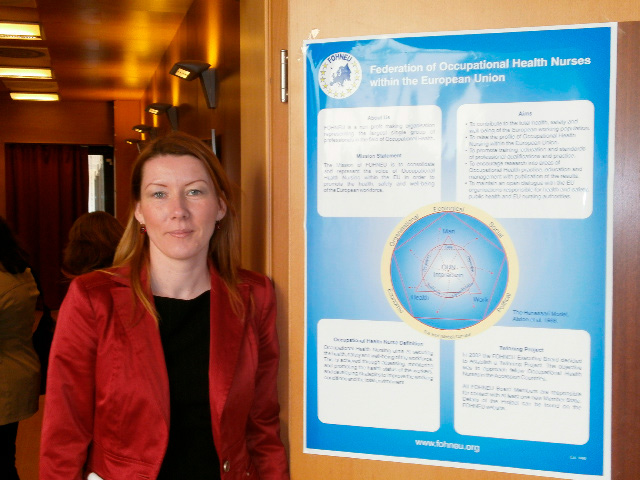
- Federation of Occupational Health Nurses within the European Union (FOHNEU)
The History and Role of Hungarian Factory Nurses
Author: Dr. Henriett Hirdi
The origins of occupational health nursing in Hungary date back to the early 20th century, with the first factory nurse training course launched in Budapest in 1933.
The factory nurse training, initiated by Dr. Mária Baloghy, was a comprehensive two-year full-time program built upon secondary education standards. It was designed to equip nurses with a broad spectrum of knowledge, including health, social, legal, and cultural aspects relevant to industrial workers. The curriculum was rigorous, requiring applicants to meet strict admission criteria, and was delivered by renowned specialists in their fields.
Students learned from distinguished experts. The training involved both theoretical instruction and extensive practical experience.
The training lasted approximately two years, with programs evolving over time to include more hours and broadened content. Initially, the courses consisted of around 800 hours of theoretical instruction, later increased to 1200 hours, covering:
- Health sciences: anatomy, physiology, hygiene, disease prevention, maternal health, infectious disease control, and occupational hazards.
- Social sciences: sociology, social policy, family health, community education.
- Legal and administrative knowledge: workers’ rights, labor laws, healthcare regulations.
- Cultural studies: arts, literature, and cultural awareness to foster holistic care.
Practical training was conducted in various settings, including factories, clinics, social institutions, and community outreach, allowing students to gain firsthand experience in health promotion, disease prevention, and social support.
Graduates of this program, known as gyárgondozónők, served as vital links between workers, employers, and health authorities. Their duties included:
- Monitoring and improving workers’ health and safety conditions within factories.
- Educating workers on hygiene, health maintenance, and disease prevention.
- Assisting in the early detection of occupational illnesses and injuries.
- Providing first aid and organizing medical treatments.
- Promoting social well-being through family and community health initiatives.
- Acting as intermediaries, advocating for workers’ health rights and collaborating with medical and social institutions.
Their functions extended beyond the factory walls, encompassing community outreach, family health education, and participation in social welfare activities. They often served as maternal figures, fostering a holistic approach to worker well-being.
Factory nurses quickly gained high esteem within industrial and social circles. Their professional skills and dedication earned them respect, and their rights were protected by collective agreements. They were seen as essential in preventing work-related illnesses, reducing absenteeism, and promoting overall productivity. Their role was viewed as a noble and socially valuable profession, combining medical expertise with social care and community engagement.
The Hungarian government and social organizations recognized the importance of structured occupational health services early on. The training program was supported by the Budapest City Council, the Ministry of Industry, and social welfare institutions. Dr. Baloghy’s pioneering efforts were instrumental in establishing this profession, which became an integral part of Hungary’s industrial health infrastructure.
Source:
Hirdi, H. É. (2013). Magyarország a foglalkozás-egészségügyi szakápoló képzés bölcsője [Hungary’s cradle of occupational health nursing training]. Nővér, (26)6: 26–40.
Hirdi, H. É. (2015). 120 éve született Baloghy Mária, a hazai gyárgondozónői képzés alapítója. [120 years since the birth of Mária Baloghy, founder of domestic factory care training.] Nővér, (28)1: 35–39.
The First Occupational Health Nurse in Hungary: The Legacy of Csermák Mária
Author: Dr. Henriett Hirdi
In the history of Hungarian healthcare, little is known about early nurses, yet their contributions are significant. One of the earliest documented figures in occupational health nursing is Csermák Mária, who served as a nurse with a mine doctor in Rudabánya. Her work began around 1883.
Dr. Árpád Fábry, the pioneer mine doctor, started practicing in 1883 and continued until 1917. His practice included a small medical office, where Csermák Mária provided nursing assistance. She was responsible for caring for the approximately 300 miners who worked in the local mine. Initially, treatment was provided in miners’ homes, with serious injuries treated in a dedicated hospital room converted from a workers’ residence.
As the workforce grew, the community built a small hospital in 1896, featuring two wards and a separate infectious diseases department. The hospital, opened in October 1897, was modern for its time, equipped with patient rooms, a surgical area, a nurse’s station, and amenities such as a wardrobe and restrooms. The hospital's design reflected contemporary standards, with a total of 12 beds across two floors and essential facilities like a kitchen and laundry.
Source: Hirdi, H. É., Szobota, L., Soós, G., & Barnaföldi, V. N. (2020). A foglalkozás-egészségügyi ápolás úttörői. [The pioneers of occupational health nursing]. Nővér, 33(6): 4–10.